Why Paper Cup Fan Forming Speed Varies on Same Machines?
Any paper cup manufacturers are trapped in a common production dilemma: even when equipped with the exact same high-speed forming machines as their competitors, they still face obvious efficiency gaps. Most efficiency issues stem from unstable paper cup fan and PE coated paper quality. Three typical puzzles trouble most cup factory owners: Why can rival factories run the same model cup machine much faster? Why do high-speed production devices frequently jam and shut down unexpectedly? Why is there a huge output difference between identical production lines?
Most manufacturers attribute low productivity to machine aging or operational mistakes. However, the fundamental reason lies in unstable physical indicators of PE coated base paper and pre-cut cup fans. Equipment performance only determines the theoretical production limit, while raw material quality directly decides the actual continuous forming speed, machine running stability, and product yield. Without qualified cup stock, even top-tier high-speed machines cannot achieve full-capacity production.

1. Unbalanced Paper Stiffness: Core Cause of Machine Jamming and Low Speed
Paper stiffness is the primary indicator that differentiates high-efficiency and low-efficiency production. Many low-cost raw materials have mismatched stiffness and flexibility. Ultra-soft base paper cannot support rapid automatic feeding and three-dimensional shaping during high-speed operation, which easily causes material deviation, cup body collapse and frequent machine jams. Every jam and shutdown forces workers to pause and reset the machine, greatly reducing hourly output.
On the contrary, excessively hard paper loses necessary ductility. Under the rapid rolling and hot-pressing sealing of high-speed equipment, rigid paper is prone to rim cracking and seam splitting. To reduce defective products, factories have to deliberately lower machine running speed. Only cup stock with balanced stiffness and flexibility can adapt to long-term high-frequency operation, ensuring continuous molding and eliminating speed limitations caused by material defects.
2. Uneven PE Coating Thickness: Hidden Barrier Restricting Forming Efficiency
Uneven PE coating is one of the most overlooked reasons for inconsistent production speed and output gaps. Many small-scale suppliers fail to guarantee uniform lamination thickness in each batch of cup fans. Partial insufficient PE coating leads to weak heat sealing adhesion, resulting in cup leakage and defective products. To control quality risks, manufacturers have to slow down the machine and extend heat sealing time for firm bonding.
In addition, locally thickened PE layers prolong the heat absorption and heat dissipation cycle, disrupting the standard high-speed molding rhythm. This invisible material defect makes it impossible for production lines to run at rated speed. Stable and uniform PE coating perfectly matches the standard working cycle of high-speed forming machines, supporting synchronous, stable and uninterrupted mass production.
3. Abnormal Paper Moisture Content: Trigger of Cracking and Frequent Shutdowns
Moisture content is a hidden key indicator that directly affects continuous production stability. It is the main cause of unstable speed and fluctuating yield in batch production. Over-dried base paper becomes extremely brittle. In the instantaneous rapid curling and extrusion of high-speed machines, brittle paper is very likely to crack at the cup rim and cup body, generating a large number of waste products.
Conversely, damp cup fans will adhere tightly to equipment molds, leading to unsmooth demolding, blocked feeding and frequent emergency shutdowns. Each equipment stop and restart will seriously affect the overall production rhythm. Professional raw material suppliers strictly control moisture content within a fixed standard range to maintain optimal paper flexibility, completely solving production obstacles brought by unqualified humidity.
4. Unstable Surface Friction Coefficient: Cause of Feeding Failure and Speed Reduction
Smooth automatic feeding is the basic premise of high-speed cup production. Unregulated surface friction coefficient is a major hidden danger for automated production lines. Cup fans with excessive surface friction will stick together during automatic separation, resulting in material stacking, feeding errors and frequent machine alarms.
Every feeding fault requires temporary shutdown for manual sorting, which severely drags down production efficiency. High-quality PE coated paper features moderate and stable surface smoothness, realizing seamless single-piece automatic feeding. It fully adapts to the fast circulation rhythm of modern high-speed forming machines and completely avoids efficiency loss caused by feeding abnormalities.
5. Unqualified Tensile Strength: Leading to Material Breakage and Forced Speed Reduction
High-speed forming requires cup stock to withstand instantaneous high-intensity curling and extrusion pressure. Raw materials with unqualified longitudinal and transverse tensile strength are easy to split and break during rapid molding. Frequent material breakage not only increases production waste but also forces factories to reduce machine speed to control defect rates.
Cup fans with stable and standard tensile strength can withstand long-term high-speed operation without deformation or cracking. They allow manufacturers to run machines at standard rated speed, maximize daily output and effectively reduce comprehensive production costs.
Conclusion
The output gap between identical paper cup production lines is never caused by equipment differences, but by unstable raw material physical indicators. Upgrading machines alone cannot break through efficiency bottlenecks. Only by matching high-standard and stable cup stock can manufacturers give full play to the performance of high-speed equipment, eliminate frequent failures, and achieve stable and efficient mass production.
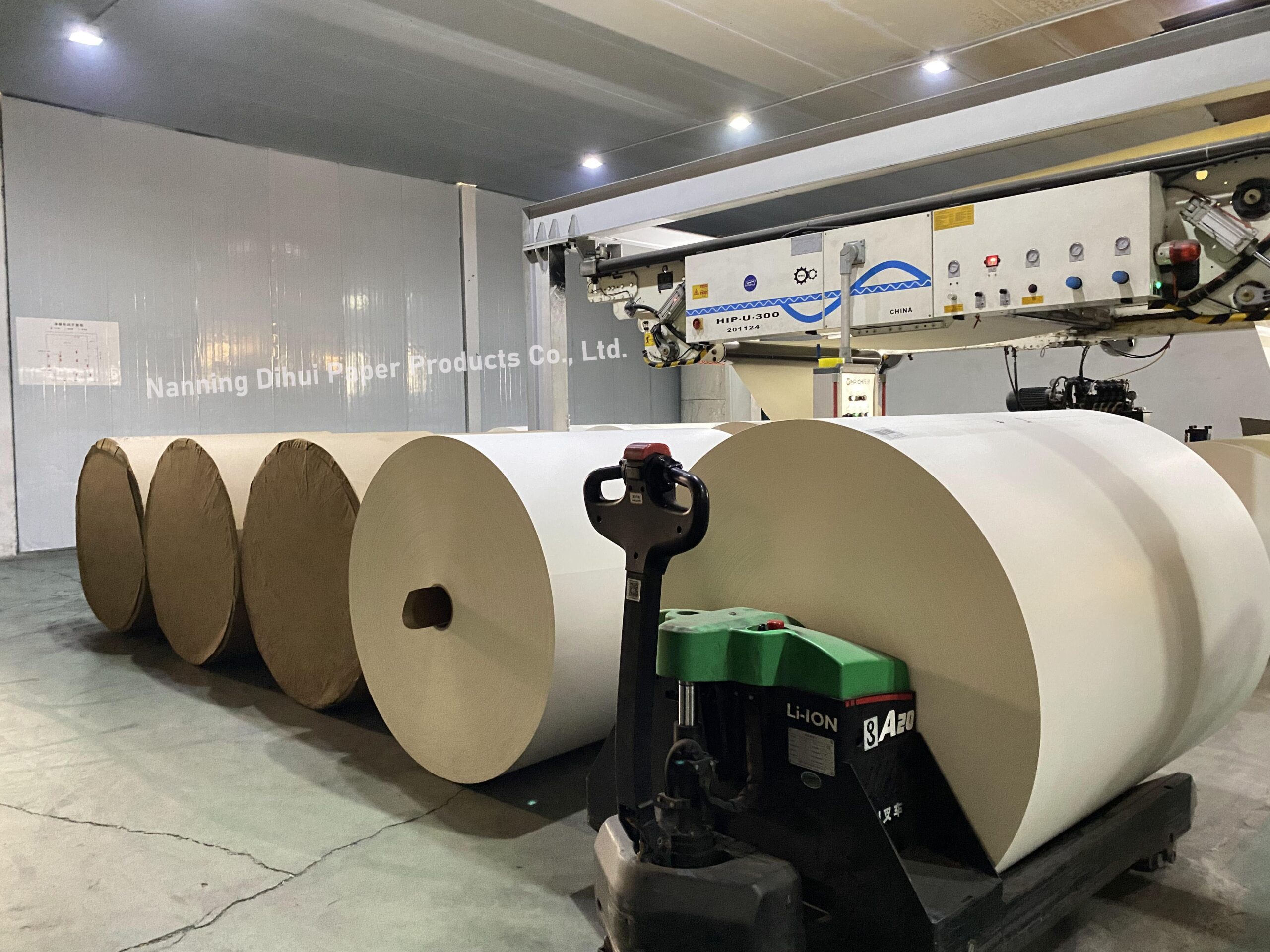
As a professional paper cup raw material manufacturer, Nanning Dihui Paper strictly controls core indicators including stiffness, PE coating uniformity, moisture content, friction coefficient and tensile strength for every batch of products. Our stable PE-coated paper rolls and pre-cut cup fans adapt to all types of high-speed and conventional forming machines, helping global customers solve jamming, cracking and low-output problems, reduce downtime and defect losses, and improve overall production profits. Contact us now for free samples and professional technical support.