How Do International Oil Prices Affect Paper Cup Materials?
In today’s global market, fluctuations in international oil prices are no longer just a concern for the energy sector—they ripple across multiple industries, including packaging. For businesses sourcing paper cup materials, understanding this connection is essential for cost control, quality assurance, and supply chain stability.
At Nanning Dihui Paper Products Co., Ltd., we have observed how fluctuations in international oil prices create a chain reaction that affects everything from raw material quotes to the final quality of the cup in a consumer’s hand.
PE Coating and the Petrochemical Chain
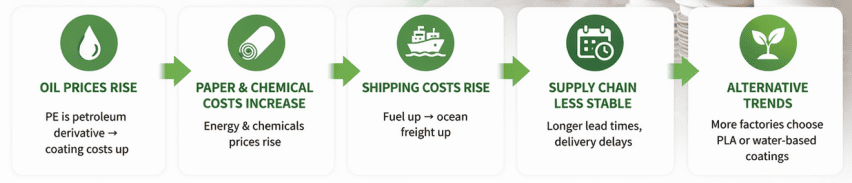
The most immediate impact of rising oil prices is the surge in the cost of Polyethylene (PE). Since PE is a direct derivative of petroleum, its market price tracks oil trends closely.
Most high-quality paper cups use a PE lining to provide a moisture barrier. When oil prices spike:
-
PE Resin Costs Rise: The raw material used for the waterproof layer becomes more expensive.
-
Overall Material Quotes Increase: Even if the paper price remains stable, the added cost of the coating pushes the total price of PE-coated paper rolls or fans upward.
A Word of Caution on Quality: In a high-cost environment, we must warn buyers that some low-price suppliers may attempt to maintain their margins by reducing the coating weight (gsm) or using inferior-grade recycled PE. This often leads to disastrous results for the end-user, such as:
-
Leaking: Poor seals at the bottom or side seams.
-
Softening: The cup loses structural integrity when filled with hot liquids.
-
Delamination: The PE layer peeling away from the base paper.
Professional advice: Always request samples before placing bulk orders. Testing is essential to verify coating quality, adhesion, and performance.
At Dihui Paper, we maintain strict standards, using only food-grade PE and adhering to the promised base paper weight (150-320gsm) regardless of market volatility.
The “Hidden” Costs: Base Paper and Energy Consumption
It is a common misconception that since paper comes from trees, it is immune to oil spikes. However, papermaking is a high-energy-consuming industry.
-
Manufacturing Energy: The process of drying, bleaching, and refining wood pulp relies heavily on natural gas and electricity—utilities that often see price hikes alongside oil.
-
Chemical Auxiliaries: Paper manufacturing requires sizing agents, bleaching agents, and wet-strength additives. These “invisible” chemical auxiliaries are mostly downstream products of the petrochemical industry.
-
Transportation of Pulp: Moving massive quantities of wood pulp from forests to mills requires fuel.
Consequently, when oil prices rise, we see a subsequent increase in the price of Base Paper/Ivory Board. This isn’t just a single-factor change; it is a full-chain cost increase. This is why we partner with premium brands like Sun Paper, Five Star, APP, Enso, Nine Dragons, JINGUI, and Yibin Paper. These established mills offer better price stability and quality consistency than smaller, fluctuating mills during economic shifts.
Logistics and the “Heavier” MOQ
Because paper cup raw materials are bulk commodities, they are primarily transported via sea freight. Rising oil prices lead to higher bunker fuel surcharges, which directly inflates shipping container costs.
For international buyers, this creates two major shifts:
-
The “Heavy” MOQ: Minimum Order Quantities become more significant because the “per unit” shipping cost is only optimized when the container is full.
-
Regional Sourcing: Clients often look for suppliers closer to home to reduce transit times and fuel exposure.
For instance, our clients in Southeast Asia (Vietnam, Thailand, Philippines) benefit significantly from our location. Being based in Guangxi, Nanning, we are geographically close to the Vietnam border. This proximity allows for more flexible shipping schedules and lower logistics costs compared to inland factories, making us a strategic partner for the ASEAN market.
Strategic Stocking
During a recent period of oil price volatility, one of our European clients noticed the upward trend early. Instead of sticking to a “Just-in-Time” (JIT) procurement model, they consulted with our team and decided to lock in a large order for strategic stock.
By placing the order before the peak of the price hike, they ensured:
-
Cost Certainty: Their production costs remained fixed while competitors faced rising prices.
-
Stability: They avoided the supply chain delays that often occur when refineries or mills slow down due to energy costs.
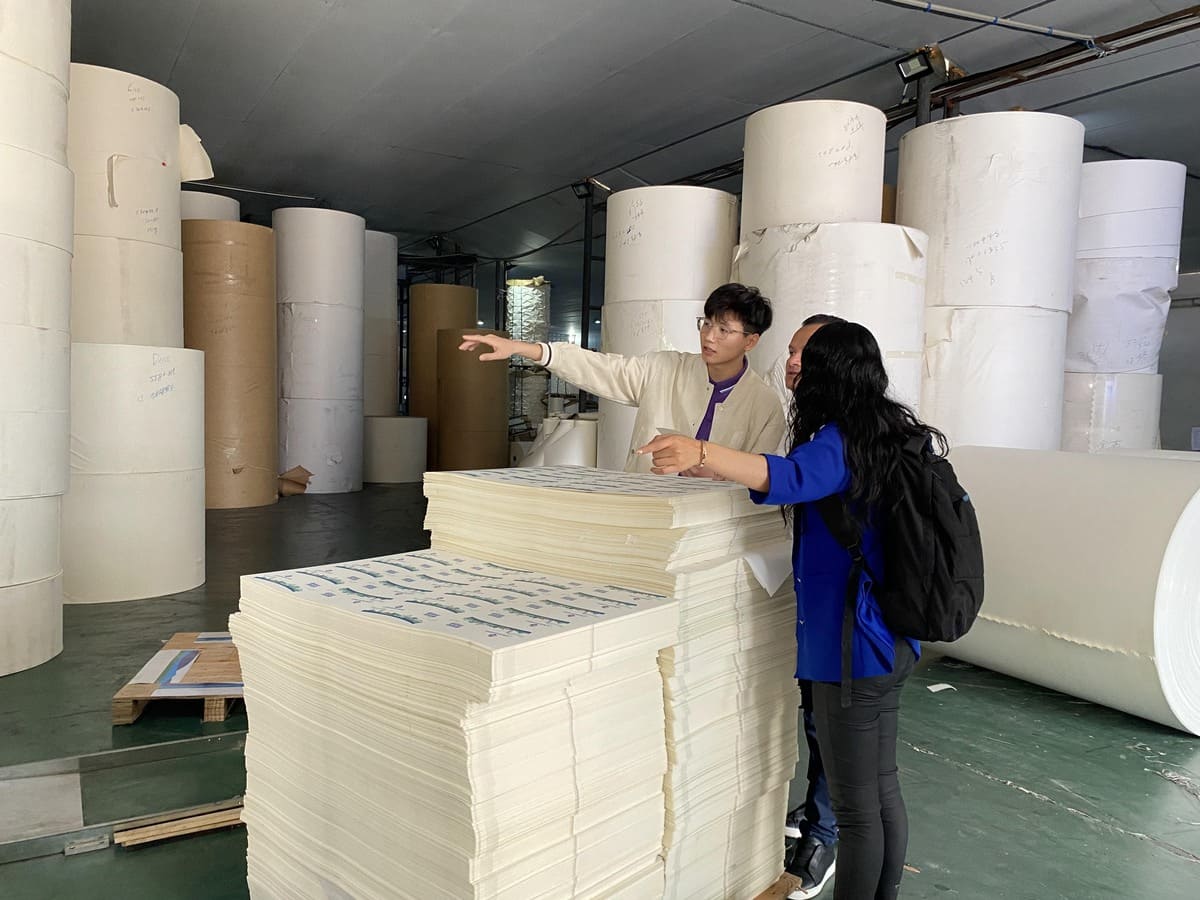
In our facility, we have the warehousing capacity to support such strategic partnerships. We don’t just sell paper; we help you manage your supply chain risk.
The Shift Toward Alternatives: PLA and Aqueous Coatings
As PE prices fluctuate, many brands are accelerating their transition to sustainable materials.
-
PLA (Polylactic Acid): While derived from corn starch, the processing and market pricing of PLA often benchmark against petroleum-based plastics. However, as PE prices rise, the “price gap” between traditional plastic and eco-friendly PLA narrows, making it a more attractive long-term investment.
-
Aqueous Coating (Water-based): This technology is becoming increasingly mature. It offers excellent recyclability and reduces the dependence on the traditional petrochemical supply chain.
At Dihui Paper, we provide free design services and samples for these newer materials, allowing you to weigh the Cost vs. Sustainability trade-off before committing to a full production run.
Conclusion
International oil prices affect paper cup materials in more ways than most buyers realize—from PE coating and base paper costs to shipping, supply chains, and even material innovation.
Understanding these connections helps you make smarter sourcing decisions, control costs, and maintain product quality.In a market defined by uncertainty, the right strategy—and the right supplier—can make all the difference.We hope that all suppliers will formulate their plans based on the above content and information to effectively navigate changes in the paper cup raw materials market.