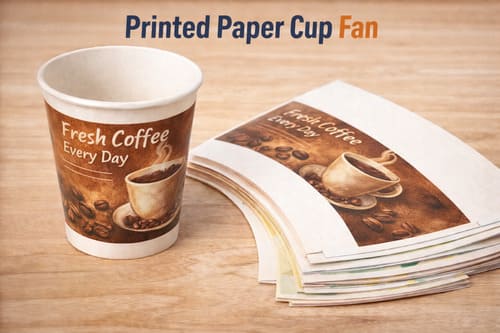
Why Do Printed Paper Cup Fan Need Reserved Blank Margins?
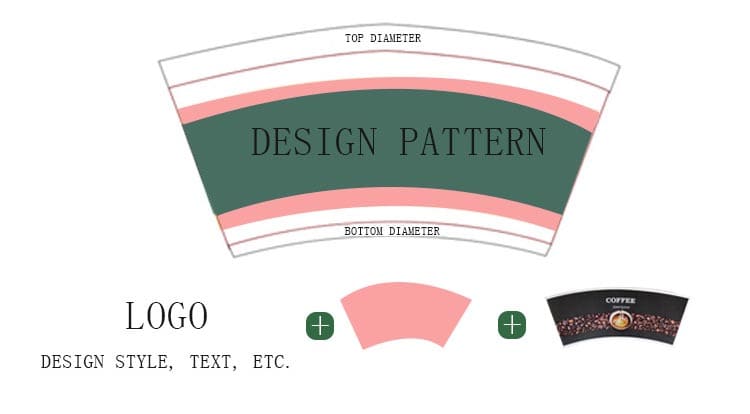
In the production of disposable paper cups, printed paper cup fan play a crucial role.One design detail that is often overlooked by people outside the packaging industry is the reserved blank margin around certain parts of the cup. These unprinted areas—typically near the cup rim and the bottom—are not accidental. They are intentionally designed to meet safety standards, ensure food contact compliance, and maintain printing quality.
Dihui Paper helps you understand why these blank spaces exist, which helps manufacturers, brand owners, and buyers make better decisions when designing custom paper cup packaging.
1. Health and Safety Considerations
One of the most important reasons for leaving blank margins on printed paper cup fan is consumer health protection.
When people drink from a disposable cup, their lips come into direct contact with the cup rim. If printed graphics extend too close to this area, there is a possibility that the lips will touch the ink layer. Although modern food-grade inks are designed to be safe, long-term direct exposure is still something manufacturers try to avoid.
In some cases, certain printing inks may contain trace chemical compounds used in pigments or solvents. Even in extremely small quantities, regulators and manufacturers prefer to eliminate the possibility of ingestion. By leaving a clean, unprinted zone near the cup rim, the design ensures that consumers only touch the paper surface rather than the printed layer.
This simple structural design significantly reduces the risk of ink transfer during normal use.
2. Preventing Ink Contamination During Stacking
Disposable paper cups are usually stacked tightly during packaging, transportation, and storage. When cups are nested together, the outer surface of one cup may come into contact with the inner surface of another.
If heavy printing appears too close to the bottom edge of the cup fan, the printed area may rub against the inner wall of another cup during stacking. Over time, friction can cause minor ink abrasion or transfer. This can lead to contamination inside the cup, which is undesirable for food-contact packaging.
By reserving blank space near the paper cup bottom area of the cup body, manufacturers create a buffer zone. Even when cups are stacked closely together, the unprinted paper surface reduces the chance of ink rubbing off or transferring to the inside of another cup.This design approach is especially important in large-scale production where millions of cups are transported and stored in bulk.
3. Compliance With Industry Standards
Food packaging materials are subject to strict regulations in many countries. These standards aim to ensure that materials in contact with food or beverages remain safe and hygienic throughout their lifecycle.
In several national standards for disposable paper cups, clear requirements are established regarding printing positions. The guidelines commonly state that printed patterns on the outside of the cup should have clear outlines, uniform colors, and no obvious staining. However, printing must not appear too close to critical areas.
For example, the design specifications typically require:
-
No printing within 15 mm from the cup rim
-
No printing within 10 mm from the cup bottom
These requirements help prevent the risks mentioned earlier, including ink ingestion and cross-contamination during stacking. Manufacturers producing printed paper cup fans must follow these guidelines carefully to ensure compliance with food packaging regulations.
4. Maintaining Printing Quality and Visual Clarity
Aside from safety considerations, leaving blank margins also improves the overall printing quality of paper cup fans.
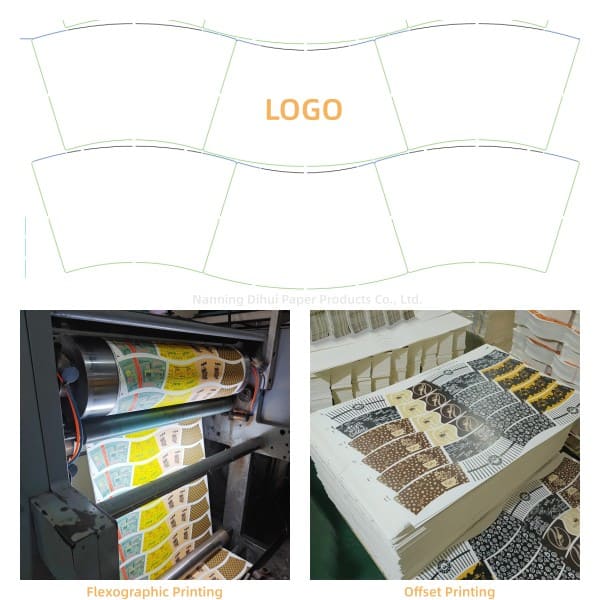
Printing on curved packaging surfaces requires precise alignment during die-cutting and forming. If designs extend too close to the edges, small positioning variations during cup forming may cause the graphics to appear distorted or uneven.
The blank margin acts as a tolerance area that allows the forming process to occur smoothly without affecting the visual integrity of the design. This ensures that logos, brand graphics, and marketing messages remain centered and visually balanced on the finished cup.
For many beverage brands, paper cups serve as mobile advertisements. Bright colors, attractive patterns, and clear logos help improve brand recognition. However, packaging design must balance marketing appeal with functional and regulatory requirements.
5. Supporting Stable Cup Forming and Sealing
During paper cup manufacturing, the printed paper cup fan is first fed into a forming machine, where it is shaped into a cylindrical cup and sealed along the side wall. At this stage, heat sealing and mechanical pressure are applied to ensure that the paper layers bond firmly together.
However, if heavy ink layers extend too close to the sealing areas, they may interfere with the bonding performance between the paper layers. As a result, the sealing strength may be reduced during the forming process. Therefore, leaving appropriate blank margins helps maintain proper adhesion strength, ensuring that the cup structure remains leak-resistant and durable.
In addition, this design also improves the stability of the forming process, especially in high-speed cup production lines. More importantly, it reduces the risk of weak seams or leakage after forming.
This is particularly important for hot beverages such as coffee or tea, where the cup must maintain strong structural integrity when exposed to heat and moisture.
6. Practical Considerations in Large-Scale Manufacturing
High-speed cup forming machines operate at thousands of cups per hour. Consistency in raw materials and printing layout helps reduce machine errors and improve production efficiency.
Blank margins provide manufacturers with operational stability by allowing minor alignment variations without affecting product quality. This reduces production waste and ensures that every batch of printed paper cup fans can run smoothly through automated equipment.
Manufacturers with strong production experience understand that small design details often play a big role in maintaining efficiency at scale.
At Dihui Paper, careful attention is given to every stage of paper cup material production—from raw paper selection to printing precision and die-cutting quality. With extensive experience in manufacturing paper cup materials, the company focuses on providing consistent quality and reliable support for customers in the global food packaging industry. Understanding details such as proper printing margins ensures that every batch of paper cup materials meets both safety expectations and practical production requirements.